
Last month in these pages we followed a bronze to the very end of its making — the torch, the chemistry, the one chance at color that a patineur gets on hot metal. It was the last performance in the life of the piece. This is the first.
A bronze does not begin as bronze. Months before any metal is poured, the sculpture exists only as clay — and before that, only as an idea about how a living thing carries its own weight. For Ken Rowe, whose wildlife bronzes have anchored Rowe Fine Art Gallery for years, that idea has to come from the animal itself. Not from a photograph. Not from memory. From something breathing in the room.
It starts with the armature: a skeleton of wire and pipe, bent and lashed together to carry the weight of the clay that will cover it. It is unglamorous work, and most sculptors do it in the studio, days ahead. Rowe, when he sculpts in public, doesn’t. “I won’t even be building the armature in advance,” he said before the last time he did this on the gallery floor. “I’m going to try to get as far as possible in the process — from the armature to the finishing touches — in just an hour and a half.”
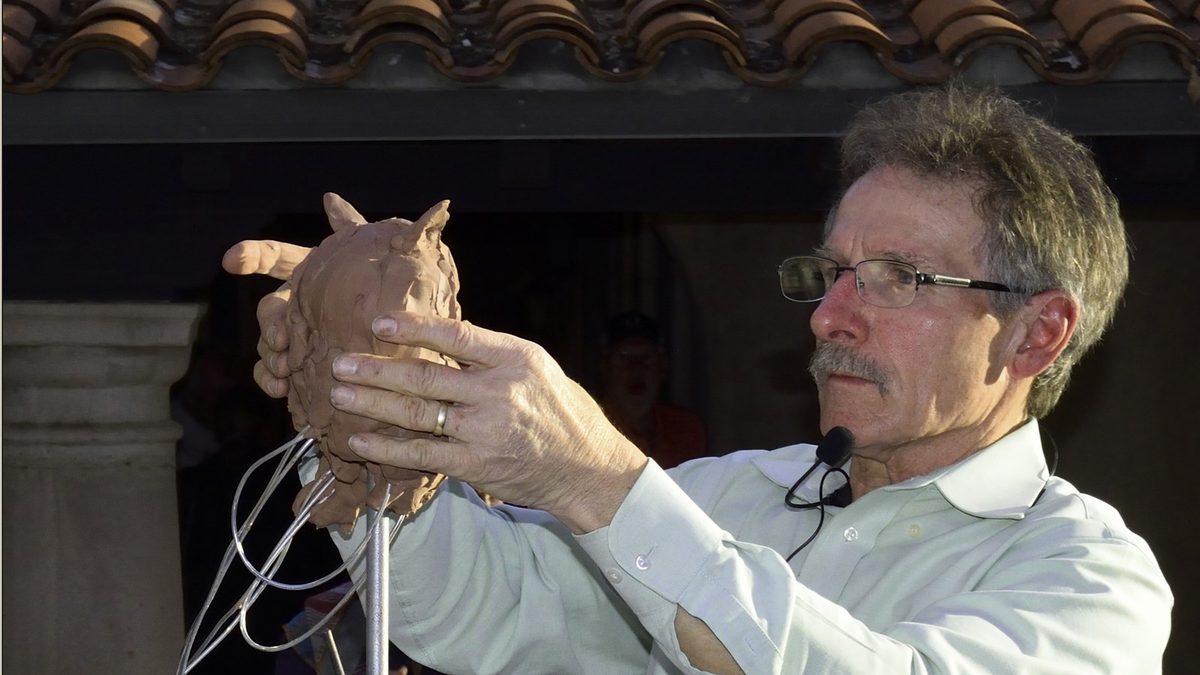
Over the armature goes plastilina — the oil-based clay sculptors have used for a century because it never dries. It can be worked for an hour or a year. Rowe presses it on in fistfuls, roughing in the mass of the body first, and only then begins the part that separates a sculpture from a figurine: finding the gesture. The way a fox settles onto its haunches. How a hawk’s shoulders load a half-second before the launch. The tilt of a head that has just heard something. Rowe spent years as a taxidermist before he ever cast a bronze, building animals from the inside out, and it gives him a working knowledge of what is under the fur — where the weight actually sits, which joints actually bend. But anatomy only tells you what is possible. The gesture tells you what is true, and it happens once.
“Working from life doesn’t give you the luxury of picking and noodling and working things out. It’s got to be fresh and spontaneous.” — Ken Rowe
That is why the model is alive. Rowe has spent his career building relationships with wildlife rehabilitation centers — the places where injured hawks, orphaned foxes, and the occasional bobcat are nursed back toward the wild — and when an animal comes in, he gets a call. “I just wait for the phone call,” he has said. He goes to the animal with clay in hand and works while it is there, which means working fast and trusting what he sees — no second sitting, no noodling. Get the gesture in that first hour and the finished bronze has it forever, through the mold, the wax, the pour, the chase, the patina. Miss it, and no amount of finishing brings it back.
There is a reason collectors almost never see this part. The foundry is far away, the studio is private, and the clay is gone by the time the bronze arrives — cast, patinated, and set on a granite base, it looks as if it had always been metal. The first hour leaves no trace on the finished piece except the one that matters most: whether the animal is alive in it.
On the first Friday in October, Rowe does the whole first hour in public: armature to finishing touches, on the gallery floor, with a live model on loan from a wildlife rescue. Which animal? He is keeping that to himself until the night. “Will our model have fur or feathers?” he asked before the last one. “You’ll have to come see to find out.” He has also warned that he tends to recruit help: “If you’re a budding artist, be prepared to get your hands dirty.”
Watch It Happen, Live — Quick Sculpt with Ken Rowe
First Friday, October 2, 2026 · 4–7pm · Rowe Fine Art Gallery, Tlaquepaque, Ste A102. The first hour in the life of a bronze, performed in person, with a surprise live model. No RSVP — walk in.
Event Details & Add to CalendarThe night before, Thursday October 1, Lana Nguyen’s Layered opens at the Creative Gateways Showroom, 5–7pm.
More from The Journal · How a Bronze Takes Its Color · Layered